article
All articlesBunny.net for Apps: Containers, Database and Storage
Bunny.net isn't just a CDN. It has containers, serverless scripts, an SQL database, storage and video hosting. Here's who it suits for running applications, how to build an app on it, and how it compares with Vercel and AWS.
- General
- 6 minutes
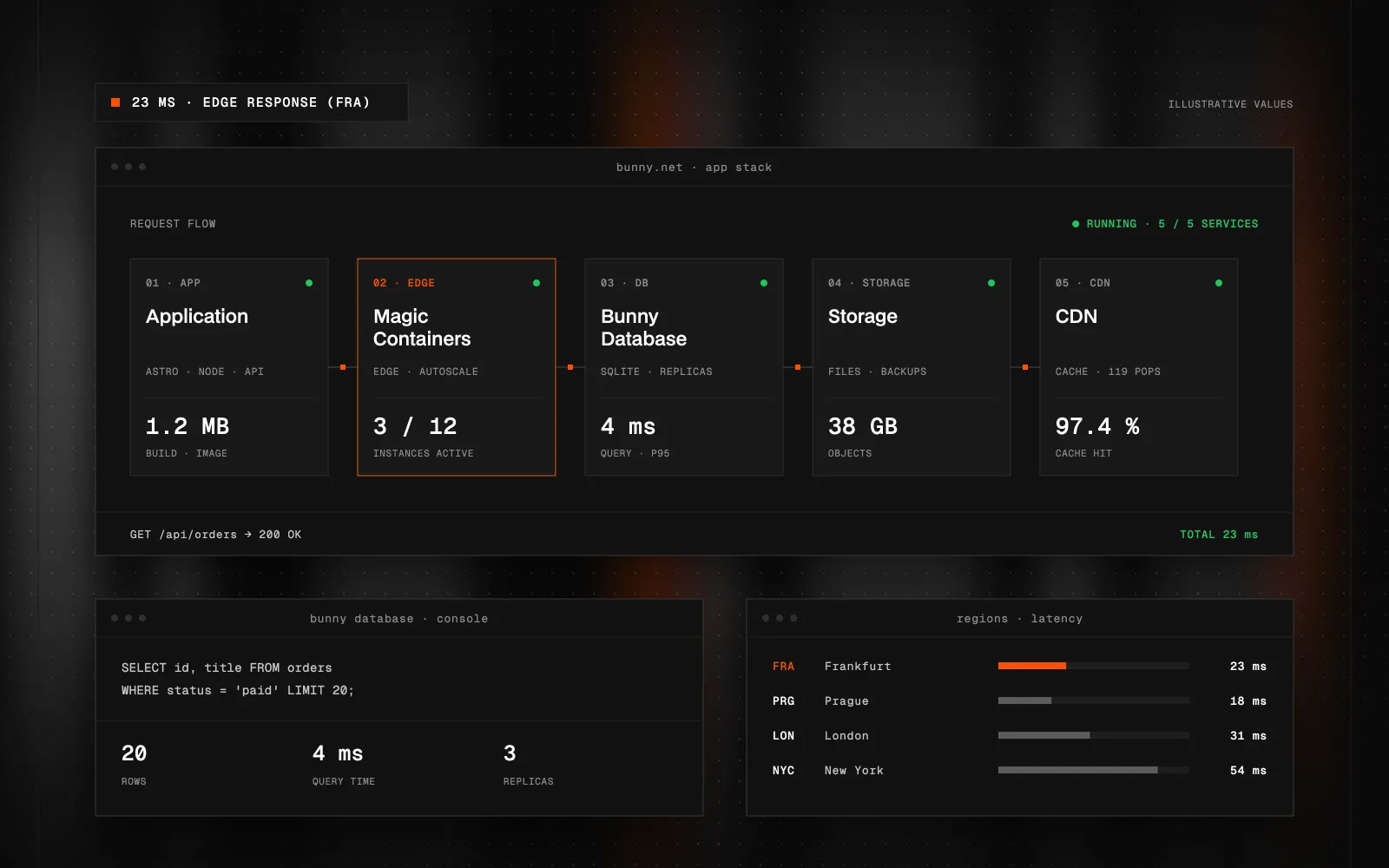
Quick Summary (TL;DR): Bunny.net is a European platform best known as a CDN and video host that now also offers tools for running whole applications. Magic Containers run your own Docker images across regions, Edge Scripting is serverless JavaScript and TypeScript at the edge, Bunny Database is a managed SQLite-compatible SQL database (still in public preview), Storage holds files, and the CDN and Stream deliver images and video. It suits small and mid-sized apps, website backends, internal tools and media-heavy projects. Compared with AWS it has fewer services but simpler controls and usage-based billing. Vercel remains the better home for a Next.js or Astro front end. In practice a combination often works best: front end on Vercel, backend and media on Bunny.
What is Bunny.net and why consider it for apps?
Bunny.net is a European platform most people know as a CDN and video host. Over time it has added tools for running whole applications: containers, serverless scripts, a database and storage. All in one account, billed by usage.
Bunny.net (referral link) offers tools for media and application hosting. It can run on its own or alongside another hosting platform. Below I explain what to consider when choosing that setup.
What does Bunny consist of?
- Magic Containers: run your own Docker images across regions. For an API, a backend or a whole app that needs to run continuously. Persistent volumes are available too.
- Edge Scripting: serverless JavaScript and TypeScript on the edge network. For short tasks, request handling, small APIs or webhooks.
- Bunny Database: a managed SQLite-compatible SQL database built on libSQL. It's in public preview, so for critical data I'd keep backups and a plan B at hand for now.
- Storage: file storage replicated across regions and wired straight into the CDN.
- CDN: delivery of static files and images, including image optimisation.
- Stream: video hosting and encoding with a player. More in how to host videos in Webflow with Bunny.
Who is Bunny a good fit for?
- Small and mid-sized apps where you don't want to manage infrastructure on AWS.
- Media-heavy projects: video, images, downloadable files.
- Teams that want a European provider and usage-based billing.
- Internal tools and website backends, such as an API for forms or data processing.
It's a weaker fit when you need a broad catalogue of managed services such as queues, search or machine learning, or when the app is tightly bound to a specific framework and its hosting.
How do you build an app on Bunny in practice?
- Package the app as a Docker image and push it to a registry, for example GitHub Container Registry.
- In Magic Containers, create an app and choose the image, regions and environment variables.
- Create a Bunny Database and attach its credentials as secrets. They reach the app as environment variables.
- Store user uploads in Storage and serve them through the CDN, not from the container.
- Point your domain and let a certificate be issued.
- Automate deployment through CI so every merge ships a new version.
For shorter tasks without your own container, you can use Edge Scripting. Access Bunny Database through its HTTP API or an SDK compatible with the runtime; keep access tokens in secrets. Check support for the libraries you need and the script's execution limits.
How does Bunny compare with Vercel and AWS?
Vercel offers Git deployments and previews for Next.js, Astro and other frameworks. It also runs backend APIs through Functions, stores files and media in Blob, and connects to databases through integrations. A comparison with Bunny should start with the workload: do you need your own container and a continuously running process, or does a functions model fit? Compare limits, regions and costs at your expected usage too.
AWS can do everything, at the price of complexity. For a smaller app it's often more setup, permissions and services than the project needs.
Bunny brings containers, a database, storage and media into one account. One option is to host the website on Vercel and selected services on Bunny; another is to keep the application with one provider. The choice depends on the workload and operational needs. I don't quote prices here because they change; estimates should use current price lists and expected consumption.
What should you watch out for?
- Bunny Database is in preview. Expect changes and keep backups.
- Access keys belong in secrets, not in code. Don't serve sensitive files publicly through the CDN.
- Check whether the built-in logs and monitoring are enough, or whether you need your own.
- If GDPR applies, pick regions based on where your data is allowed to live.
What to take away
Bunny.net is worth considering if you want containers, a database, storage and media delivery in one ecosystem. Before deciding, compare service limits, release status, backups and costs for your project. You can try it through my referral link. And if you're deciding what to build your own app or website on, drop me a line.
FAQ
Is Bunny.net just a CDN?
No. Besides the CDN it offers video hosting (Stream), file storage (Storage), serverless scripts (Edge Scripting), containers (Magic Containers) and an SQL database (Bunny Database).
Can I run a Next.js app on Bunny?
Yes, as a container in Magic Containers. Vercel offers smoother framework integration, though, so I usually keep the front end there and put the backend and media on Bunny.
Is Bunny Database ready for production?
It's in public preview. It's usable for smaller projects and experiments; for critical data, plan for backups and changes.
Is Bunny cheaper than Vercel or AWS?
It depends on the workload. Bunny bills by usage and the price list is public, so you can run the comparison for your specific project.
Why Bunny instead of AWS?
Simplicity. For a smaller app Bunny is quicker to set up and its billing is easier to follow. AWS makes sense when you need services Bunny doesn't offer.

Got a project a template can't handle?
Tell me what you need. I'll get back with scope, a plan and a price estimate.
STATUS:OPEN FOR PROJECTS· REPLY WITHIN 2 DAYS